
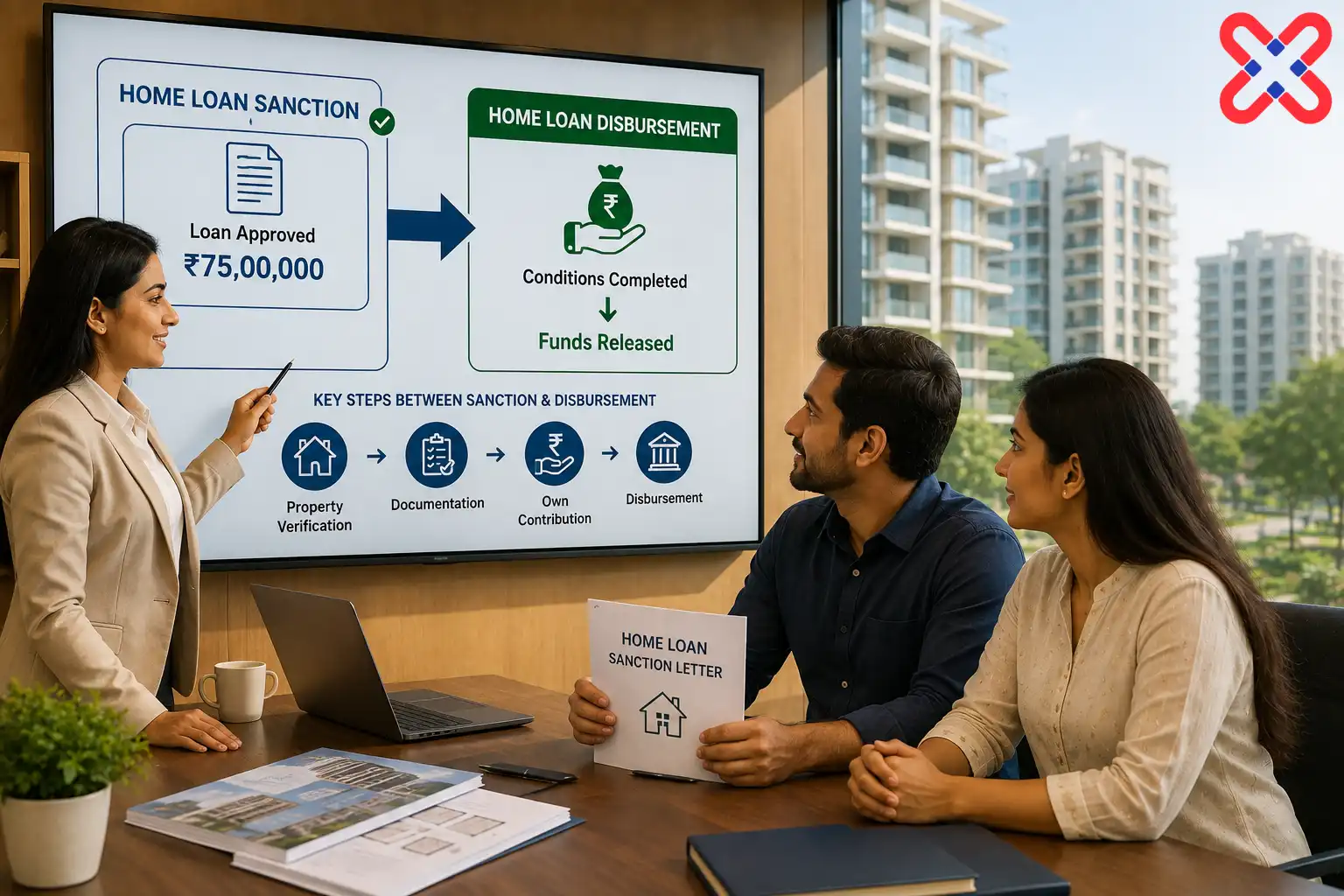
Home Loan Sanction vs Disbursement: What Changes?
Receiving a home loan sanction can feel like the final step in obtaining finance for a property purchase.
It is certainly an important milestone—but loan sanction and loan disbursement are not the same thing.
A sanction broadly indicates that the lender has assessed the borrower and agreed to offer a home loan, subject to specified terms and conditions. Disbursement occurs later, when the lender actually releases the approved funds in accordance with the loan and property transaction.
Understanding what happens between these stages can help home buyers plan their purchase more effectively.
What Is a Home Loan Sanction?
A home loan application typically begins with an assessment of the borrower’s financial profile.
Depending on the applicant, the lender may examine factors such as:
- income;
- employment or business profile;
- existing financial obligations;
- credit history;
- age;
- repayment capacity; and
- requested loan amount and tenure.
If the application meets the lender’s requirements, the lender may issue a sanction letter setting out the principal terms on which it is prepared to provide the loan.
The sanction therefore represents an important approval stage, but it should not automatically be interpreted as confirmation that the entire sanctioned amount is immediately available for release.
What Does a Sanction Letter Usually Contain?
The precise format differs between lenders, but a home loan sanction letter may specify matters such as:
- sanctioned loan amount;
- applicable interest rate or rate structure;
- proposed tenure;
- repayment terms;
- validity of the sanction;
- applicable fees or charges; and
- conditions that must be satisfied before disbursement.
Borrowers should read the sanction carefully rather than focusing only on the approved amount.
The conditions attached to the sanction can be particularly important because some of them may need to be completed before funds are released.
What Is Home Loan Disbursement?
Disbursement is the stage at which the lender releases loan funds after the applicable requirements have been satisfied.
Depending on the transaction, funds may be released to the seller, developer or another appropriate recipient in accordance with the underlying property transaction and lender procedures.
Disbursement can occur as a single payment or in stages.
For example, a completed property transaction may involve a different disbursement process from an under-construction property where payments become due progressively.
The important distinction is straightforward:
Sanction = approval of the loan subject to applicable terms
Disbursement = actual release of loan funds
Why Can There Be a Gap Between Sanction and Disbursement?
The lender’s assessment does not end entirely with the borrower’s income and credit profile.
A home loan is also connected to a particular property.
Before releasing funds, the lender may need to complete or satisfy requirements relating to the property, transaction and loan documentation.
Consequently, a borrower may receive a sanction letter while some steps required for disbursement are still pending.
The length of this period can depend on the property, transaction, documentation and lender process.
Property Verification Matters
A borrower may be financially eligible for a home loan while the property itself still requires assessment.
Depending on the transaction and lender, the property may be examined from legal and technical perspectives.
The lender may review relevant ownership and property documentation and assess whether the property meets its financing requirements.
This distinction is important because borrower approval and property acceptance are separate elements of a home-loan transaction.
A sanction based on the borrower’s profile should therefore not be treated as unconditional approval of every property the borrower may subsequently choose.
The Property Valuation Can Affect Financing
The amount a buyer agrees to pay for a property and the value considered by the lender for financing purposes may not always be identical.
The lender may undertake its own valuation or assessment as part of the home-loan process.
If the value considered by the lender is lower than the transaction price, the amount the lender is prepared to finance may be affected, subject to applicable loan-to-value requirements and lender policy.
The buyer may then need to arrange a greater contribution from personal funds.
This is one reason buyers should avoid assuming that the sanctioned amount will necessarily be disbursed in full for any property.
Your Own Contribution May Need to Be Paid First
Home loans generally finance only an eligible portion of the property value or transaction.
The borrower must arrange the required contribution from personal sources.
Depending on the lender and transaction structure, evidence that the borrower’s required contribution has been paid may be necessary before or alongside disbursement.
Home buyers should therefore plan their down payment and other transaction costs separately from the loan amount.
A sanction letter does not eliminate the requirement for the borrower’s own contribution.
Documentation Must Be Completed
Before disbursement, the lender may require completion of the relevant loan documentation and fulfilment of conditions specified in the sanction.
Depending on the transaction, this may include:
- execution of loan documents;
- property-related documentation;
- fulfilment of sanction conditions;
- payment of applicable charges;
- completion of security-related requirements; and
- submission of any outstanding documents.
Requirements vary according to the lender, borrower and property.
Borrowers should obtain a clear list of pending conditions rather than assuming that sanction automatically triggers payment.
Full and Partial Disbursement
Not every home loan is released in one instalment.
For a completed property, the eligible loan amount may be released in accordance with the payment requirements of the transaction once the lender’s conditions are satisfied.
For an under-construction property, disbursement may occur progressively based on construction stages, payment demands and lender requirements.
A sanctioned loan of ₹80 lakh, for example, does not necessarily mean ₹80 lakh will be released immediately.
The lender may initially release only the amount required and eligible at that particular stage.
EMI and Pre-EMI
The repayment mechanism can also depend on how the loan is disbursed.
Where the entire loan has been disbursed, regular EMI repayment generally proceeds according to the agreed repayment schedule.
Where an under-construction loan is disbursed in stages, the borrower may, depending on the lender and loan structure, initially pay interest on the amount actually disbursed. This is commonly referred to as pre-EMI interest.
Borrowers should understand when their repayment obligation begins and how it changes as further amounts are disbursed.
Does Sanction Guarantee Disbursement?
Not necessarily.
A sanction indicates that the lender is prepared to extend the loan subject to the terms and conditions specified.
Disbursement still depends upon completion of the applicable requirements.
Issues involving property documentation, valuation, transaction structure, outstanding conditions or changes in the borrower’s circumstances can potentially affect the subsequent process.
Borrowers should therefore treat sanction as a major approval milestone—but not as the same event as receiving the loan funds.
Watch the Sanction Validity Period
A sanction may remain valid only for a specified period.
This can become relevant where a borrower obtains approval before finalising a property or where the transaction takes longer than anticipated.
If the sanction expires before disbursement, the lender may require an extension, updated documentation or reassessment according to its prevailing process and policies.
Home buyers should therefore check the validity period shown in the sanction letter and plan the transaction accordingly.
What Should You Check After Receiving Sanction?
Instead of considering the financing process complete, review the sanction carefully.
In particular, understand:
How much has been sanctioned?
Confirm the approved amount.
What are the loan terms?
Review the rate, tenure and repayment structure.
What conditions remain outstanding?
Identify requirements that must be completed before disbursement.
Has the property been fully accepted?
Do not assume borrower sanction automatically completes property-related assessment.
How will the loan be disbursed?
Understand whether funds will be released fully or progressively.
When will repayment begin?
Clarify the applicable EMI or pre-EMI structure.
From Approval to Actual Funding
Home loan sanction and disbursement are connected stages, but they serve different purposes.
Sanction primarily establishes the lender’s willingness to provide finance on specified terms. Disbursement occurs after the relevant conditions are fulfilled and represents the actual release of funds.
For a home buyer, the practical sequence is therefore:
Application → Assessment → Sanction → Property & Documentation Requirements → Disbursement → Repayment
Understanding this sequence can prevent a common mistake: treating the sanction letter as though the property transaction has already been fully funded.
A home loan becomes practically available for the purchase only when the applicable disbursement requirements are completed and the lender releases the funds.
Looking to Discuss an Opportunity?
Connect with Magnet Capital Partners to discuss your requirements and explore how our advisory capabilities may assist.
Disclaimer
This article forms part of Insights — The Magnet Knowledge Series and is intended solely for general informational and educational purposes. It does not constitute investment, financial, legal, tax, regulatory, real estate or other professional advice, nor does it constitute an offer, solicitation, recommendation or assurance in relation to any investment, transaction, product, service or return.
Any information, views, examples, calculations, illustrations, scenarios, projections, estimates or references to valuations, yields, returns, interest rates, financial performance, market conditions or other quantitative or qualitative measures contained in this article are general or illustrative in nature. They should not be interpreted as actual, assured, promised or indicative future outcomes. Actual circumstances and outcomes may differ materially depending upon applicable facts, assumptions, market conditions, commercial considerations, regulatory requirements and other relevant factors.
Readers should undertake their own evaluation and obtain appropriate independent professional advice before making any investment, financial, business, transaction, real estate or other decision. Information contained in this article may change over time and may not reflect subsequent developments. Magnet Capital Partners makes no representation or warranty, express or implied, regarding the accuracy, completeness or continuing relevance of the information contained herein and accepts no liability arising from reliance upon or use of this article, to the extent permitted by applicable law.
Copyright
© Magnet Capital Partners. All rights reserved.
The original editorial content, organisation, structure and presentation of Insights — The Magnet Knowledge Series are protected by applicable copyright laws. No part of this article may be reproduced, republished, distributed, transmitted, adapted or commercially used, in whole or in substantial part, without the prior written permission of Magnet Capital Partners, except as permitted by applicable law. References to third-party information, data, regulations, concepts, terminology, trademarks or other materials remain subject to the rights of their respective owners, where applicable.