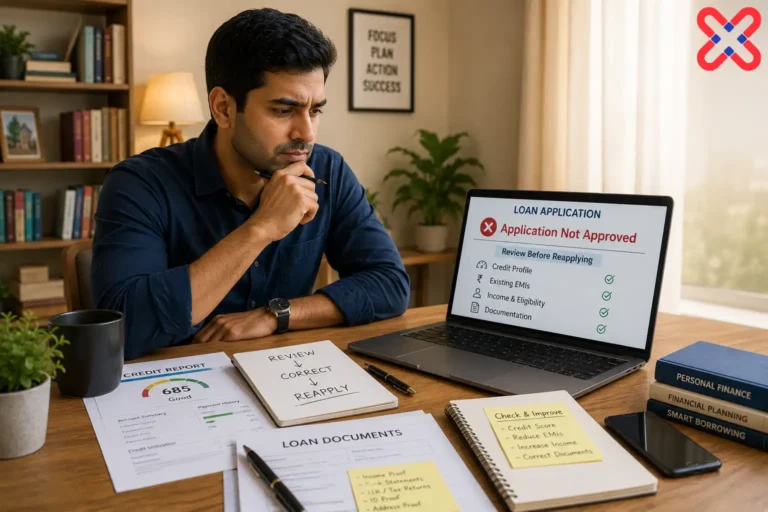

Personal Loans: Know the True Cost of Borrowing
Personal loans are designed around convenience.
They are generally unsecured, can often be processed without providing property as collateral, and may provide relatively quick access to funds for eligible borrowers. That flexibility can make a personal loan useful when a genuine financial requirement arises.
But convenience has a cost.
A borrower deciding whether to take a personal loan should look beyond the amount sanctioned and the monthly EMI. The more meaningful assessment includes the interest rate, tenure, processing charges, repayment structure, prepayment terms, existing obligations and total amount ultimately repaid.
A loan that appears affordable every month can still be expensive over its full tenure.
The appropriate question is therefore not simply:
“Can I afford this EMI?”
It is:
“What will this borrowing ultimately cost me, and is that cost appropriate for the purpose for which I am borrowing?”
What Is a Personal Loan?
A personal loan is generally an unsecured loan provided to an eligible individual without requiring a property or other specific asset to be mortgaged as collateral.
Because the lender does not have the same form of asset security that exists in a home loan or Loan Against Property, the lender’s assessment places considerable importance on the borrower’s ability and willingness to repay.
This may include evaluation of:
- income;
- employment;
- employer profile;
- credit history;
- credit score;
- existing EMIs;
- banking conduct;
- age;
- repayment capacity; and
- other applicable credit parameters.
The absence of collateral makes personal loans convenient for suitable borrowers, but it can also make them more expensive than certain secured forms of borrowing.
Why Do People Take Personal Loans?
Personal loans can be used for various permitted personal requirements, subject to lender policy and applicable terms.
These may include:
- medical or family expenditure;
- education-related expenses;
- weddings;
- travel;
- home renovation;
- relocation;
- purchase of eligible consumer items;
- debt consolidation; or
- other legitimate personal requirements.
The flexibility is useful because the borrower may not need to provide an asset specifically linked to the purpose of the loan.
But flexibility should not remove financial discipline.
A ₹5 lakh loan remains a ₹5 lakh financial obligation whether it finances an unavoidable requirement or discretionary consumption.
The purpose therefore matters.
The Interest Rate Is Only the Starting Point
Suppose a borrower requires:
₹5 lakh
and is offered a personal loan at an illustrative:
12% per annum
The borrower may focus immediately on the 12% rate.
But that does not reveal the complete economics.
The actual cost will also depend upon:
- tenure;
- processing fee;
- applicable taxes and charges;
- insurance or other products, if voluntarily or otherwise appropriately included;
- prepayment or foreclosure terms, where applicable; and
- how quickly the outstanding principal reduces.
Most importantly, the borrower needs to know how much will ultimately be repaid.
Example: ₹5 Lakh for Three Years
Consider a hypothetical:
Loan amount: ₹5 lakh
Interest rate: 12% p.a.
Tenure: 3 years
The approximate EMI would be:
₹16,607 per month
Over 36 months, the borrower would repay approximately:
₹5.98 lakh
Approximate interest paid:
₹97,900
The borrower therefore receives ₹5 lakh but repays approximately ₹5.98 lakh before considering processing fees and other applicable charges.
That is the first level of understanding the true cost.
Now Extend the Same Loan to Five Years
Suppose the same ₹5 lakh loan at the same illustrative 12% rate is instead taken for:
5 years
The approximate EMI falls substantially to:
₹11,122 per month
That appears attractive.
The borrower has reduced the monthly commitment by approximately:
₹5,485
But over 60 months, total repayment becomes approximately:
₹6.67 lakh
Approximate interest paid:
₹1.67 lakh
Compare the two:
| 3 Years | 5 Years | |
|---|---|---|
| Loan | ₹5.00 lakh | ₹5.00 lakh |
| Illustrative Rate | 12% | 12% |
| Approx. EMI | ₹16,607 | ₹11,122 |
| Approx. Total Repayment | ₹5.98 lakh | ₹6.67 lakh |
| Approx. Interest | ₹0.98 lakh | ₹1.67 lakh |
The five-year option saves approximately ₹5,485 every month in EMI.
But it costs approximately ₹69,000 more in interest over the life of the loan.
This illustrates one of the most important principles in retail borrowing:
Lower EMI does not necessarily mean cheaper borrowing.
Affordability and Cost Are Different Questions
The three-year loan may be cheaper overall but place greater pressure on monthly cash flow.
The five-year loan may be easier to service every month but cost more overall.
Neither choice is automatically correct.
For someone with comfortable monthly surplus, the shorter tenure may be preferable because it reduces total interest.
For someone whose finances cannot safely accommodate the higher EMI, choosing an excessively short tenure simply to save interest could create repayment stress.
The appropriate tenure therefore needs to balance:
Monthly Affordability
with
Total Borrowing Cost
Processing Fees Change the Effective Cost
Suppose the ₹5 lakh loan carries an illustrative processing fee of:
2%
That equals:
₹10,000
If applicable GST is charged on the fee, the borrower’s total upfront cost increases further.
More importantly, depending upon the lender’s disbursement mechanism, the processing fee may sometimes be deducted from the sanctioned amount.
For illustration:
Sanctioned loan: ₹5,00,000
Processing fee: ₹10,000
Other applicable deductions: assume ₹2,000
Actual amount reaching the borrower:
₹4,88,000
Yet the repayment obligation may still be calculated on the sanctioned ₹5 lakh according to the loan terms.
This is why borrowers should distinguish between:
Loan sanctioned
and
Net amount actually received.
Compare APR, Not Merely the Headline Rate
Where applicable, the Annual Percentage Rate (APR) provides a broader measure of borrowing cost because it incorporates the interest rate and specified charges into an annualised figure.
RBI’s Key Facts Statement framework requires regulated lenders to disclose APR and other important loan information for covered retail and MSME term loans, helping borrowers compare the effective cost of different offers.
Suppose:
Lender A: Interest rate 11.75%
Lender B: Interest rate 12.00%
At first glance, Lender A appears cheaper.
But suppose Lender A has materially higher processing and other applicable charges.
The effective cost difference may become much smaller—or potentially change the relative attractiveness of the two offers.
Therefore:
Lowest advertised interest rate ≠ automatically lowest overall borrowing cost.
Why Credit Score Matters
Because personal loans are unsecured, the borrower’s credit profile can play an important role in underwriting and pricing.
A strong repayment record may help demonstrate responsible credit behaviour.
Conversely:
- missed payments;
- excessive existing debt;
- high credit utilisation;
- multiple recent borrowing enquiries; or
- adverse repayment history
may affect eligibility or the terms offered.
Two people earning the same salary do not necessarily receive the same personal-loan terms.
Their existing obligations and credit profiles can be very different.
Example: Same Income, Different Capacity
Consider two individuals who each earn:
₹1,00,000 per month
Borrower A
Existing EMIs: ₹10,000
Borrower B
Existing EMIs: ₹45,000
Now suppose both consider a new personal loan requiring an EMI of:
₹20,000
Borrower A’s total EMI obligations become:
₹30,000 per month
Borrower B’s become:
₹65,000 per month
The new loan is identical.
Their incomes are identical.
But their resulting financial positions are clearly not identical.
This demonstrates why income alone does not determine affordability.
Existing obligations matter.
Maximum Eligibility Is Not the Same as Appropriate Borrowing
Suppose a borrower requires:
₹3 lakh
but the lender indicates eligibility for:
₹8 lakh
The additional ₹5 lakh is not a financial gain.
If the borrower takes the full ₹8 lakh merely because it is available, that additional borrowing creates:
- additional interest;
- higher EMI;
- greater outstanding debt; and
- potentially unnecessary expenditure.
The appropriate amount should generally begin with:
“How much do I genuinely need?”
rather than:
“What is the maximum amount I can get?”
The Purpose of the Loan Matters
Consider two borrowers taking identical ₹5 lakh personal loans.
Borrower A
Requires funds for an unavoidable medical or family requirement and has sufficient income to service the resulting EMI.
Borrower B
Uses the entire amount for discretionary spending that would otherwise have been postponed.
Financially, both borrowers owe the same principal.
But the rationale for accepting the cost of borrowing is different.
This does not mean borrowing for discretionary expenditure is inherently prohibited or inappropriate.
It means the borrower should consciously ask whether the benefit obtained from spending the money justifies the interest and charges paid to obtain it today rather than saving for it first.
Personal Loan Versus Credit Card Debt
Personal loans and revolving credit-card balances should not be treated as interchangeable merely because both can be unsecured.
Suppose an individual has accumulated a substantial revolving credit-card balance carrying a materially higher financing cost than an available personal loan.
In some circumstances, replacing eligible higher-cost revolving debt with a lower-cost structured personal loan could reduce financing cost and provide a defined repayment schedule.
But there is an important behavioural risk.
Imagine:
Credit-card balance: ₹3 lakh
The borrower takes a ₹3 lakh personal loan and clears it.
If the borrower then starts accumulating another ₹3 lakh credit-card balance while continuing to repay the personal loan, the debt problem has not been solved.
It has doubled.
Debt consolidation works only if it is accompanied by repayment discipline and control over new borrowing.
Personal Loan Versus Loan Against Property
Suppose a borrower requires:
₹15 lakh
and owns an eligible property.
Should the borrower take a personal loan or a Loan Against Property?
A personal loan may provide:
- no property mortgage;
- relatively simpler documentation in suitable cases;
- potentially quicker processing; and
- no direct collateral exposure.
A LAP may potentially provide:
- lower interest rates than unsecured borrowing;
- longer tenure;
- potentially larger funding capacity; and
- consequently lower EMI for the same principal,
but requires acceptable property security and exposes that property to the borrowing.
For a relatively small, short-term requirement, mortgaging an important property may be disproportionate.
For a substantially larger requirement over a longer period, the cost difference between secured and unsecured borrowing may become more significant.
The appropriate decision depends upon amount, purpose, tenure, cost, repayment capacity and collateral risk.
Prepayment Can Reduce Interest—But Read the Terms
Suppose a borrower takes a five-year personal loan but receives a substantial bonus after two years.
Using part of that money to prepay the outstanding loan could potentially reduce future interest cost.
However, the borrower should understand:
- whether part-prepayment is permitted;
- when it is permitted;
- minimum prepayment amounts;
- applicable charges, if any;
- whether tenure or EMI changes; and
- how the payment is applied to principal.
The regulatory treatment of prepayment charges has also evolved. RBI’s Pre-payment Charges on Loans Directions, 2025, effective for loans sanctioned or renewed on or after January 1, 2026, prohibit such charges in specified circumstances, including floating-rate loans to individuals for non-business purposes from covered regulated entities; other situations remain subject to the applicable framework and disclosed terms.
Borrowers should therefore check the terms of their specific loan, rather than relying on a general assumption that prepayment is always free or always chargeable.
Example: What Prepayment Can Achieve
Suppose a borrower takes:
₹10 lakh
at an illustrative 12%
for 5 years.
The EMI is approximately:
₹22,244
After two years, suppose the borrower receives additional funds and makes a meaningful part-prepayment directly against principal.
Provided the loan terms allow it, reducing the outstanding principal earlier means future interest is calculated on a smaller balance.
If the borrower can continue paying approximately the same EMI, the remaining tenure can potentially reduce considerably.
The general principle is straightforward:
Principal repaid earlier stops generating interest for the remaining period.
The exact saving depends upon the outstanding balance, timing, rate, amount prepaid and applicable charges.
Avoid Borrowing to Invest Merely Because Returns “May Be Higher”
Suppose someone is offered a personal loan at:
12%
and believes an investment can generate:
15%
It may appear that borrowing at 12% and investing at 15% creates a 3% profit.
That reasoning is incomplete.
The 12% borrowing cost is contractual, subject to the loan terms.
The 15% investment return is generally not guaranteed.
Taxes, fees, market volatility and potential investment losses can further change the outcome.
Borrowing unsecured money to pursue uncertain investment returns can therefore materially increase financial risk.
A prospective return should not be treated as equivalent to a contractual borrowing cost.
Emergency Borrowing Still Requires Repayment Planning
Sometimes a personal loan is considered because the financial requirement is urgent.
In such situations, borrowers understandably focus on obtaining the funds quickly.
But urgency should not eliminate the repayment assessment.
Even when the purpose is unavoidable, the borrower should understand:
How much EMI can the household absorb?
What financial buffer will remain after the EMI?
What happens if income temporarily declines?
Can unnecessary expenditure be reduced while the loan is outstanding?
Obtaining emergency funding solves the immediate liquidity requirement.
It does not eliminate the subsequent repayment obligation.
Do Not Ignore Late-Payment Consequences
A personal loan is a contractual repayment commitment.
Delayed or missed payments can potentially result in:
- penal charges in accordance with applicable terms;
- collection activity;
- adverse credit-history consequences; and
- greater difficulty obtaining future credit.
A borrower should therefore choose an EMI that can be serviced not only during financially comfortable months but with some allowance for unexpected expenditure.
An EMI that consumes every rupee of monthly surplus leaves little room for financial disruption.
A Useful Stress Test
Suppose your proposed EMI is:
₹20,000 per month
Ask:
Could I still service this EMI if my monthly disposable income temporarily fell by 15–20%?
The answer does not create a formal lending rule.
But as a personal financial discipline, it can help reveal whether the proposed borrowing leaves an adequate buffer.
Borrowing capacity and financial resilience are not necessarily the same thing.
When Can a Personal Loan Make Sense?
Subject to individual circumstances, a personal loan may merit consideration when:
- there is a genuine funding requirement;
- unsecured borrowing is appropriate for the amount and purpose;
- the borrower has sufficient repayment capacity;
- the tenure is reasonable;
- the total borrowing cost is understood;
- the EMI leaves an adequate financial buffer; and
- alternative sources of funding have been appropriately considered.
When Should a Borrower Be More Cautious?
Greater caution may be appropriate when:
- the borrowing is primarily driven by impulsive consumption;
- existing EMI obligations are already substantial;
- repayment depends upon uncertain future income;
- the borrower is taking more than actually required;
- a long tenure is being chosen only to make an otherwise unaffordable loan appear affordable;
- the borrower does not understand applicable fees and charges; or
- the loan is being used to finance speculative investment.
Convenient access to credit should not substitute for an assessment of whether the debt is genuinely appropriate.
Questions to Ask Before Taking a Personal Loan
Before proceeding, understand:
Requirement — How much do I actually need?
Purpose — Is borrowing appropriate for this expenditure?
Interest Rate — What rate am I actually being offered?
APR — What is the effective annualised cost including applicable charges?
Net Disbursement — How much money will actually reach me?
EMI — Can I service it comfortably?
Tenure — Am I reducing EMI by paying interest for unnecessarily long?
Total Repayment — How much will I ultimately repay?
Processing Charges — What will be deducted or separately payable?
Prepayment — Can I repay early and on what terms?
Existing Debt — How much of my income is already committed?
Financial Buffer — Can I withstand an unexpected expense or temporary income disruption?
The answers provide a more meaningful picture than the sanctioned amount alone.
The Broader Perspective
A personal loan can be a useful financial instrument because it provides eligible borrowers with access to funds without requiring specific property collateral.
Its convenience, however, can make it easy to focus on speed, eligibility and EMI while overlooking the total economics.
The difference between a well-considered personal loan and an expensive financial burden often lies not in the product itself, but in:
how much is borrowed, why it is borrowed, how long it remains outstanding and whether the repayment fits comfortably within the borrower’s finances.
A disciplined borrower should therefore not ask only:
“What EMI can I get?”
but:
“What is the true cost of this loan, can I comfortably carry it, and is the purpose worth that cost?”
That is the more meaningful basis for a personal borrowing decision.
Looking to Discuss an Opportunity?
Connect with Magnet Capital Partners to discuss your requirements and explore how our advisory capabilities may assist.
Disclaimer
This article forms part of Insights — The Magnet Knowledge Series and is intended solely for general informational and educational purposes. It does not constitute investment, financial, legal, tax, regulatory, real estate or other professional advice, nor does it constitute an offer, solicitation, recommendation or assurance in relation to any investment, transaction, product, service or return.
Any information, views, examples, calculations, illustrations, scenarios, projections, estimates or references to valuations, yields, returns, interest rates, financial performance, market conditions or other quantitative or qualitative measures contained in this article are general or illustrative in nature. They should not be interpreted as actual, assured, promised or indicative future outcomes. Actual circumstances and outcomes may differ materially depending upon applicable facts, assumptions, market conditions, commercial considerations, regulatory requirements and other relevant factors.
Readers should undertake their own evaluation and obtain appropriate independent professional advice before making any investment, financial, business, transaction, real estate or other decision. Information contained in this article may change over time and may not reflect subsequent developments. Magnet Capital Partners makes no representation or warranty, express or implied, regarding the accuracy, completeness or continuing relevance of the information contained herein and accepts no liability arising from reliance upon or use of this article, to the extent permitted by applicable law.
Copyright
© Magnet Capital Partners. All rights reserved.
The original editorial content, organisation, structure and presentation of Insights — The Magnet Knowledge Series are protected by applicable copyright laws. No part of this article may be reproduced, republished, distributed, transmitted, adapted or commercially used, in whole or in substantial part, without the prior written permission of Magnet Capital Partners, except as permitted by applicable law. References to third-party information, data, regulations, concepts, terminology, trademarks or other materials remain subject to the rights of their respective owners, where applicable.