
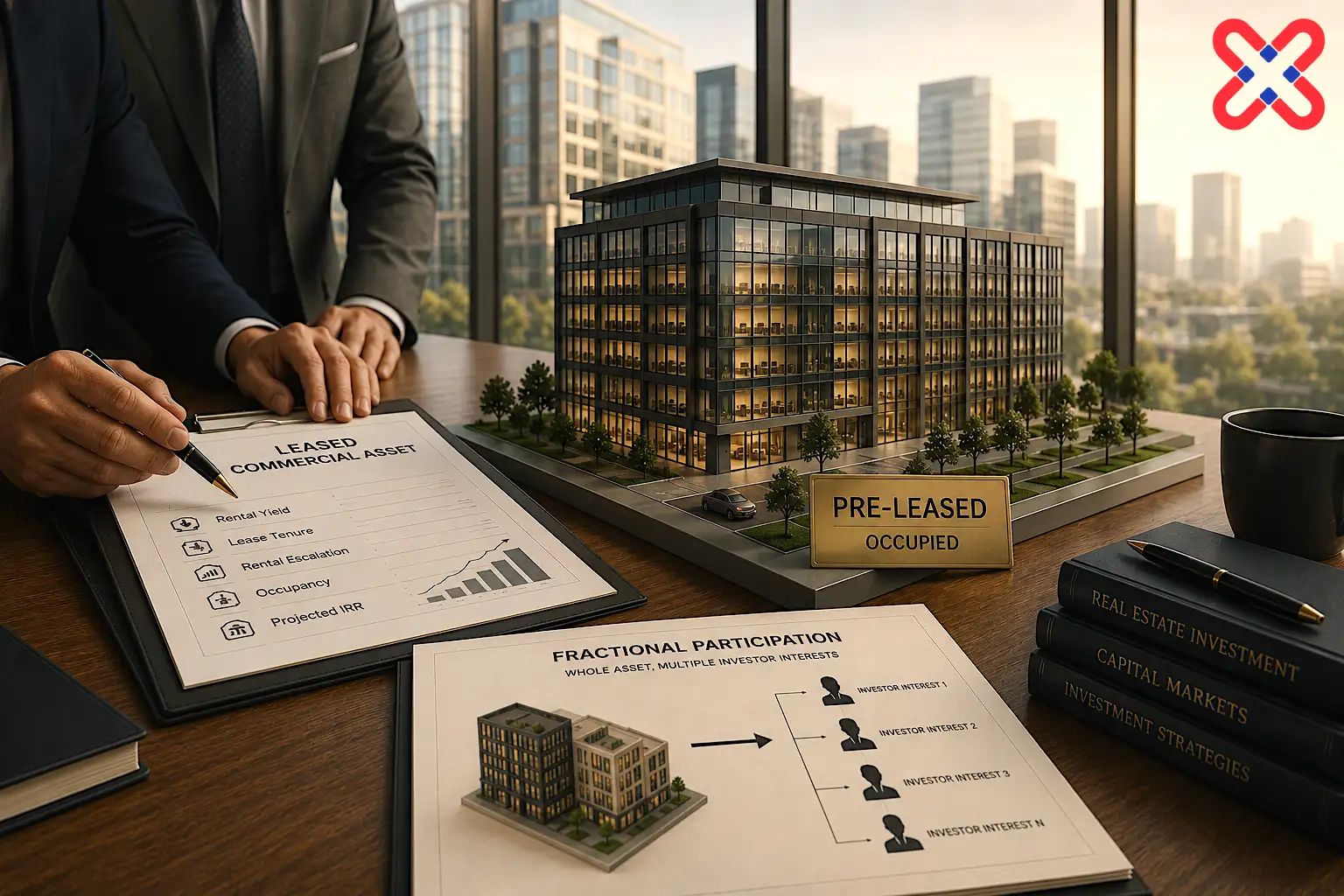
Pre-Leased Real Estate: A Practical Guide
Pre-leased commercial real estate occupies a distinctive position within property investment. Unlike purchasing a vacant property and subsequently searching for a tenant, an investor acquires an asset that is already leased and generating rental income.
The underlying property may be an office, an entire commercial building, retail premises, a warehouse, an industrial facility or another income-producing commercial asset. The investment may involve acquiring the entire property directly or participating in a larger asset through an appropriately structured fractional or pooled investment.
The attraction is straightforward: an existing asset, an existing tenant, an existing lease and an identifiable stream of rental income from the outset.
That does not make pre-leased real estate risk-free. Rental income, tenant quality, lease terms, acquisition valuation, future vacancy, financing, property appreciation and eventual exit value collectively determine the investor’s ultimate return.
Understanding these components is essential before comparing pre-leased property with conventional alternatives such as a bank fixed deposit.
What Is a Pre-Leased Property?
A pre-leased or pre-rented property is a completed property that already has a tenant when it is acquired by an investor.
The purchaser generally steps into the position of the existing owner under the lease arrangement, subject to the transaction documents and applicable law, and becomes entitled to future rental income.
For example, consider an office floor occupied by a corporate tenant paying ₹5 lakh per month. An investor purchasing the property does not have to first locate a tenant to begin generating rental income. Subject to the transaction and lease terms, the existing tenancy continues and the new owner receives the rent.
This distinguishes it from a vacant commercial property.
A vacant property may eventually generate an attractive rental return, but the purchaser must first identify a suitable tenant, negotiate commercial terms and complete the leasing process. During that period, the asset may generate no rental income while continuing to incur ownership costs.
What Types of Properties Can Be Pre-Leased?
Pre-leased investments can arise across several commercial real-estate segments, including office buildings and office floors, retail premises, high-street commercial properties, warehouses, logistics facilities, industrial properties, healthcare and educational properties, and other completed income-generating assets.
The nature of the underlying property matters because rental economics, tenant requirements, reletting prospects, lease structures and capital values can vary significantly between asset classes.
For example, an office floor leased to a large corporate presents a different investment proposition from a high-street retail property occupied by a restaurant or a warehouse leased to a logistics company.
The investor therefore needs to evaluate both the property and the income attached to it.
Investing in an Entire Property
The traditional route is direct ownership.
An investor may acquire an entire commercial unit, office floor, building, warehouse or other property and become the owner of the underlying real estate.
For example, an investor might acquire an entire ₹10 crore office floor already leased to a corporate tenant. The investor owns that property directly and, subject to the lease and applicable law, receives the rental income generated from it.
A larger investor might instead acquire an entire ₹100 crore commercial building occupied by one or several tenants.
Direct ownership provides substantial control over the asset. Subject to contractual and legal restrictions, the owner can make decisions concerning financing, future leasing, sale timing and property management.
However, direct ownership can require substantial capital and may create concentration risk because a significant amount of an investor’s wealth can become tied to one property, location or tenant.
Fractional Investment in Commercial Real Estate
Fractional investment seeks to make larger income-producing properties accessible without requiring one investor to fund the entire acquisition.
Instead of one investor acquiring the whole asset, multiple investors participate economically in the property through an appropriate ownership or investment structure.
Consider a simplified example.
Suppose an institutional-quality commercial property has a value of ₹100 crore and is leased to a large corporate tenant.
An individual investor may neither wish nor be able to invest ₹100 crore in the entire building. A structured investment arrangement could instead enable multiple investors to obtain economic exposure to the asset.
An investor contributing ₹1 crore should not, however, assume that this means a particular ₹1 crore worth of physical office space inside the building belongs to that investor for personal occupation.
This is the important distinction.
Fractional participation does not ordinarily mean that the physical property is divided into individually identifiable cabins, rooms or floor areas that each investor can personally possess and use.
For example, suppose 100 investors participate economically in a commercial building.
If the corporate tenant subsequently vacates the building, an investor cannot ordinarily say:
“I own 1% of this investment, so I will occupy 1% of the building and establish my own office there.”
There may be no separately demarcated physical space corresponding to that investor’s economic interest.
The investor’s rights instead arise from the specific legal and investment structure through which the property is held.
The underlying real estate is entirely physical. What is fractional is the investor’s economic and legal participation in the investment, rather than necessarily the personal possession of a separately identified physical portion of the building.
This makes it particularly important to understand what the investor actually owns, who holds title to the property, who controls leasing decisions, how rental income is distributed, what fees apply and how the investment can eventually be exited.
India’s regulatory framework for fractional real-estate investing has also evolved through SEBI’s Small and Medium Real Estate Investment Trust (SM REIT) framework. SM REIT schemes are intended for completed, income-generating real estate; the framework requires at least 95% of scheme assets to comprise completed and revenue-generating properties.
Why Investors Consider Pre-Leased Assets
The principal attraction is income visibility.
Before acquisition, an investor can ordinarily examine the existing rent, lease tenure, lock-in period where applicable, rental escalation provisions, security deposit, tenant profile and contractual allocation of various property expenses.
For example, suppose an office property is already leased for five years, incorporates a contractual rental escalation every three years and is occupied by an established corporate tenant.
That provides considerably more information for assessing future cash flows than buying an identical vacant property and assuming that an appropriate tenant will eventually be found.
However, visibility should not be confused with certainty.
A lease is an important contractual arrangement, but investment risk does not disappear merely because a lease exists.
Rental Yield: The Starting Point
One of the simplest measures used to assess a pre-leased property is its rental yield.
At a basic level:
Gross Rental Yield = Annual Rent ÷ Property Acquisition Value × 100
Consider an illustrative property acquired for ₹10 crore that generates annual rent of ₹70 lakh.
The initial gross rental yield is:
₹70 lakh ÷ ₹10 crore = 7.0%
But gross rental yield is not necessarily the return ultimately retained by the investor.
Property taxes, maintenance obligations, asset-management expenses, transaction costs, financing costs and other applicable expenses may reduce the net income.
Accordingly, investors should distinguish between headline gross yield and actual net cash yield.
Rental Escalation Can Change the Economics
Commercial leases may contain contractual rent escalations.
Suppose the same ₹10 crore property initially generates ₹70 lakh annually and its lease provides for periodic escalation.
The investor’s rental income could consequently rise during the holding period.
For example, if the contractual annual rent eventually increases from ₹70 lakh to ₹80.5 lakh, the cash yield measured against the investor’s original ₹10 crore acquisition price becomes approximately 8.05% before applicable costs.
The investor’s return is therefore not necessarily limited to the rental yield prevailing on the acquisition date.
Over time, the investment can potentially generate returns through two principal components:
1. Rental income
2. Capital appreciation
It is the interaction between these components that makes IRR useful when evaluating longer-term real-estate returns.
Capital Appreciation: The Second Component
Commercial property can appreciate over time, but appreciation should never be treated as guaranteed.
Value can be influenced by location, building quality and age, tenant profile, prevailing rent, lease tenure, vacancy levels, infrastructure development, demand and supply, interest rates, capitalisation rates and broader economic conditions.
Consider the ₹10 crore property again.
If it is sold several years later for ₹12 crore, the investor has potentially earned both rental income during ownership and ₹2 crore of gross capital appreciation.
But if market conditions weaken and the property can be sold for only ₹9 crore, the investor has experienced capital depreciation that offsets part of the rental income earned during the holding period.
This is why rental yield alone provides an incomplete picture.
Understanding the Overall IRR
Internal Rate of Return (IRR) considers both the amount and timing of investment cash flows.
For a pre-leased property, those cash flows can include the initial acquisition outflow, periodic net rental income, rental escalations and the eventual proceeds from selling the property or investment interest.
Consider a simplified illustration.
An investor acquires a property for ₹10 crore. It initially produces a 7% gross rental yield. Rent subsequently escalates, and after several years the investor sells the property at a higher value.
The combination of recurring rental cash flows and capital appreciation may produce an IRR higher than the original 7% rental yield.
Conversely, suppose the tenant leaves, the property remains vacant for twelve months and the eventual sale price is below expectations.
The realised IRR could fall substantially.
Therefore:
Rental yield is not IRR.
Rental yield measures income relative to property value at a particular point. IRR attempts to capture the overall investment outcome across the holding period.
Can Pre-Leased Real Estate Generate Double-Digit IRRs?
Potentially, yes—but a double-digit IRR should never be presented as assured merely because an asset is pre-leased.
For illustration, imagine a property acquired at a 7% initial rental yield with periodic rental escalation. If the property remains occupied, rents rise as anticipated and the property appreciates during a multi-year holding period, the combination could potentially result in a double-digit IRR.
Change one assumption, however, and the result can be very different.
Suppose the tenant leaves in year three, the property remains vacant for twelve months, reletting requires expenditure and the eventual exit value is lower than originally expected. The resulting IRR could be materially below the original projection.
A professional analysis should therefore consider several scenarios:
Base Case — reasonable rental, occupancy and exit assumptions.
Upside Case — stronger rental growth, continued occupancy and/or higher appreciation.
Downside Case — vacancy, reletting costs and weaker exit value.
The resulting range is more informative than presenting a single projected return as though it were guaranteed.
Pre-Leased Property Versus a Bank Fixed Deposit
The comparison with a Fixed Deposit (FD) is useful because many investors naturally compare recurring rental income with recurring interest income.
The two investments are nevertheless fundamentally different.
RBI’s published banking indicators in July 2026 showed term-deposit rates above one year broadly in the 6.00%–6.75% range.
| Consideration | Bank Fixed Deposit | Pre-Leased Commercial Real Estate |
|---|---|---|
| Nature | Financial deposit | Real-estate investment |
| Primary income | Contractual interest | Rental income |
| Return visibility | Relatively high | Dependent on lease and tenant |
| Capital appreciation | None on principal | Possible |
| Market-value risk | Limited if held as contracted, subject to applicable bank/credit framework | Property value can rise or fall |
| Vacancy risk | None | Yes |
| Tenant risk | None | Yes |
| Liquidity | Generally easier, subject to deposit terms | Usually lower |
| Transaction costs | Relatively limited | Can be significant |
| Potential return drivers | Interest | Rent + escalation + appreciation |
| Return certainty | Contractually defined, subject to terms | Not assured |
Consider a simplified comparison.
An investor places ₹1 crore in an FD carrying 6.5% annual interest. Ignoring tax and compounding differences for illustration, the principal return driver is the contracted interest rate.
Alternatively, ₹1 crore invested through an appropriate structure into pre-leased commercial real estate may generate rental distributions and potentially participate in appreciation of the underlying property.
If the property performs strongly, the overall return could exceed the FD return.
If the tenant vacates, expenses rise or the property’s value declines, the outcome could be less favourable.
The potentially higher return therefore comes with additional risk rather than being a free enhancement to the FD return.
The Vacancy Risk
Vacancy is one of the most important risks in income-producing real estate.
A property may be pre-leased when acquired, but no tenant necessarily remains forever.
The lease may expire. A tenant may exercise a contractual termination right. Its business circumstances may change. It may relocate, consolidate operations or reduce its space requirements.
Once the property becomes vacant:
rental income can stop.
Consider an office producing ₹5 lakh per month.
If it remains vacant for six months, the investor may lose ₹30 lakh of gross rental income before considering any other costs.
A twelve-month vacancy could represent ₹60 lakh of foregone gross rent.
Meanwhile, property taxes, maintenance, security, insurance or other ownership expenses may continue.
The owner may additionally incur brokerage, refurbishment, fit-out contributions or incentives to attract a replacement tenant.
Vacancy can therefore affect an investment in two directions simultaneously: income stops while some expenses continue.
The Fractional Investor Faces Vacancy Too
Fractional participation does not remove the economic consequences of vacancy.
Suppose 100 investors participate in a commercial property leased to one corporate tenant.
If that tenant vacates, the investors cannot avoid the economic impact simply because each holds only a fractional interest.
Rental distributions may reduce substantially or stop, depending upon the structure and available reserves.
Nor can each investor ordinarily occupy a corresponding fraction of the vacant building for personal use.
The investment remains dependent upon the property being relet, operated or eventually sold in accordance with the governing structure.
This is an important distinction between fractional economic ownership and direct personal possession of usable real estate.
Tenant Concentration Risk
A property occupied by a single tenant creates concentration.
If the tenant pays regularly, the investment can produce stable income.
If that tenant vacates, rental income from the entire property may disappear.
Consider two ₹50 crore commercial properties.
Property A is entirely occupied by one tenant.
Property B has ten tenants occupying approximately 10% each.
If Property A’s tenant vacates, potentially 100% of its rental income becomes exposed.
If one tenant in Property B vacates, approximately 10% may become vacant while the remaining tenants continue paying rent, assuming the other leases remain unaffected.
Multi-tenancy does not eliminate risk, but it can reduce dependence upon a single tenant.
Credit Quality Matters
The financial quality of the tenant can materially influence both income visibility and property valuation.
Investors commonly examine the tenant’s financial strength, operating history, creditworthiness, industry outlook, lease-payment history and strategic importance of the location.
For example, a nine-year lease with a financially stressed tenant is not necessarily safer than a shorter lease with a financially strong tenant.
The duration of the contract matters, but so does the counterparty’s ability and willingness to honour it.
Lease Tenure and Lock-In Are Not the Same
Investors should distinguish between lease tenure and lock-in period.
Suppose a property is marketed as having a nine-year lease.
That sounds like nine years of rental visibility.
But if the lease permits the tenant to terminate after a three-year lock-in subject to specified conditions, the economic position is different.
The investor should therefore examine the actual lease, including termination provisions, escalation clauses, security deposit, renewal rights and other material conditions.
The economics lie in the lease document, not merely in the headline lease tenure.
Liquidity and Exit Risk
Real estate is generally less liquid than conventional bank deposits and many listed financial instruments.
Selling an entire commercial property can require time for buyer identification, negotiations, due diligence, financing and documentation.
Fractional participation can reduce the amount of capital required to gain exposure to a property, but a smaller investment ticket does not automatically mean easy liquidity.
An investor should therefore understand the exit mechanism before investing.
Questions include:
Who can purchase the investor’s interest?
Is there an organised market?
Are transfers restricted?
How is the sale price determined?
What happens if an investor wants to exit but other investors do not?
Could the entire underlying property eventually be sold?
These considerations can materially affect realised returns.
Interest Rates and Property Values
Commercial property valuations can also be influenced by prevailing interest rates and the returns investors demand.
Consider a property generating ₹70 lakh of annual rent.
If investors are comfortable purchasing comparable assets at a 7% yield, the implied value is approximately ₹10 crore.
If market conditions change and investors begin demanding a higher yield for comparable risk, the price they are prepared to pay for the same rental stream may decline.
Conversely, lower required yields can support higher property valuations.
This relationship helps explain why comparing commercial property with fixed-income investments is economically relevant. Investors generally expect additional potential return to compensate for illiquidity, vacancy risk and property-specific uncertainty.
Advantages of Pre-Leased Commercial Real Estate
Potential advantages include immediate rental income, greater initial cash-flow visibility, contractual rental escalation, possible capital appreciation, exposure to a tangible underlying asset and the potential for portfolio diversification.
High-quality assets may also provide access to established corporate tenants and institutional commercial locations.
Fractional structures can potentially allow investors to participate in larger properties that would otherwise require substantially greater capital.
Perhaps most importantly, pre-leased property potentially provides two sources of economic return—income during ownership and value at exit.
Disadvantages and Risks
Those potential benefits need to be assessed against meaningful risks.
Vacancy risk: rental income can stop if the tenant leaves.
Tenant-default risk: a lease does not eliminate counterparty risk.
Illiquidity: selling the investment may take time.
Capital-value risk: property prices can fall.
Concentration risk: one property or tenant can represent substantial exposure.
Transaction costs: stamp duty, registration, brokerage, legal expenses and other costs may affect direct acquisitions.
Maintenance and capital expenditure: buildings require continuing expenditure.
Reletting costs: securing a new tenant may involve brokerage, refurbishment, fit-outs or incentives.
Interest-rate sensitivity: higher required investment yields can put pressure on property valuations.
Structural risk: fractional investors need to understand exactly how their interest is legally and economically held.
Return uncertainty: unlike a contracted FD rate, the ultimate IRR from real estate cannot be known at the beginning.
Direct Ownership or Fractional Investment?
Neither route is inherently superior.
Direct ownership may suit an investor with sufficient capital who values control over the underlying asset and accepts the associated concentration and management responsibilities.
Fractional or pooled participation may suit an investor seeking exposure to larger income-producing properties without funding the entire acquisition.
For example:
An investor with ₹25 crore might choose to acquire an entire smaller commercial property directly.
Another investor with ₹25 lakh or ₹1 crore might seek appropriately structured participation in a much larger institutional asset.
But the second investor needs to analyse two investments simultaneously:
the underlying real estate, and
the structure through which exposure to that real estate is obtained.
The quality of an attractive building cannot compensate automatically for a poor investment structure, and a sound structure cannot make an unattractive property a good investment.
What Should an Investor Evaluate?
A pre-leased property should not be evaluated merely by asking:
“What is the rental yield?”
A more complete assessment considers the asset, location, tenant, lease, prevailing and contractual rent, escalation provisions, vacancy risk, reletting potential, ownership costs, investment structure, liquidity and expected exit value.
Consider two properties both offering a 7% headline rental yield.
The first is a modern office in a strong commercial micro-market, occupied by a financially sound tenant with appropriate lease protections and good reletting potential.
The second is an ageing building in a weaker location, dependent upon one financially weaker tenant and difficult to relet.
The headline yield is identical.
The investment proposition is not.
Likewise, two fractional opportunities involving similar properties can differ because their legal structures, fees, governance, distribution policies and exit mechanisms differ.
Investment analysis therefore needs to move beyond the headline number.
Income Today, Value Tomorrow
The fundamental appeal of pre-leased commercial real estate is the possibility of combining current income with longer-term value creation.
A well-located property occupied by a financially sound tenant, supported by an appropriate lease and acquired at a sensible valuation can potentially provide recurring rental income while retaining exposure to appreciation in the underlying real estate.
But the additional return potential relative to a conventional fixed deposit is not free.
The investor assumes property risk, tenant risk, vacancy risk, liquidity risk and capital-value risk.
A property that was pre-leased when purchased does not necessarily remain occupied throughout the investment period. A fractional interest does not ordinarily provide personal possession of a corresponding physical portion. And an assumed future sale value is not guaranteed.
The appropriate question is therefore not simply:
“Does this property yield more than an FD?”
A more meaningful question is:
“Does the risk-adjusted combination of rental income, escalation, potential appreciation and eventual exit value adequately compensate for the additional risks?”
That distinction is central to understanding pre-leased commercial real estate as an investment.
Looking to Discuss an Opportunity?
Connect with Magnet Capital Partners to discuss your requirements and explore how our advisory capabilities may assist.
Disclaimer
This article forms part of Insights — The Magnet Knowledge Series and is intended solely for general informational and educational purposes. It does not constitute investment, financial, legal, tax, regulatory, real estate or other professional advice, nor does it constitute an offer, solicitation, recommendation or assurance in relation to any investment, transaction, product, service or return.
Any information, views, examples, calculations, illustrations, scenarios, projections, estimates or references to valuations, yields, returns, interest rates, financial performance, market conditions or other quantitative or qualitative measures contained in this article are general or illustrative in nature. They should not be interpreted as actual, assured, promised or indicative future outcomes. Actual circumstances and outcomes may differ materially depending upon applicable facts, assumptions, market conditions, commercial considerations, regulatory requirements and other relevant factors.
Readers should undertake their own evaluation and obtain appropriate independent professional advice before making any investment, financial, business, transaction, real estate or other decision. Information contained in this article may change over time and may not reflect subsequent developments. Magnet Capital Partners makes no representation or warranty, express or implied, regarding the accuracy, completeness or continuing relevance of the information contained herein and accepts no liability arising from reliance upon or use of this article, to the extent permitted by applicable law.
Copyright
© Magnet Capital Partners. All rights reserved.
The original editorial content, organisation, structure and presentation of Insights — The Magnet Knowledge Series are protected by applicable copyright laws. No part of this article may be reproduced, republished, distributed, transmitted, adapted or commercially used, in whole or in substantial part, without the prior written permission of Magnet Capital Partners, except as permitted by applicable law. References to third-party information, data, regulations, concepts, terminology, trademarks or other materials remain subject to the rights of their respective owners, where applicable.