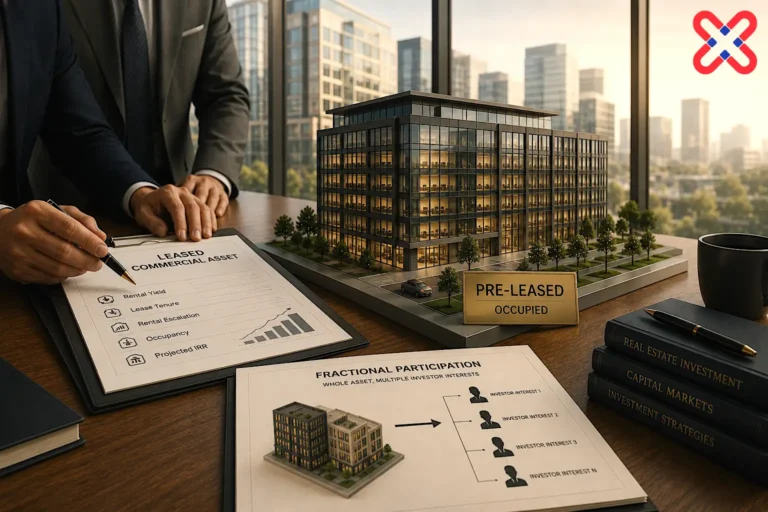

Pre-Leased Property: A Smart Investment Guide
Rental Income. Real Asset. Potential for Appreciation.
For investors looking beyond traditional fixed-income investments, pre-leased commercial property can offer an attractive combination of regular rental income, capital appreciation and ownership of a tangible asset.
Unlike a vacant commercial property, a pre-leased property already has a tenant and an existing lease in place. The investor therefore acquires an asset that is already generating rental income, rather than taking on the immediate task of finding a tenant.
For investors seeking income today and potential wealth creation over the long term, this can make pre-leased property an interesting investment avenue.
But what exactly is a pre-leased property? What types of assets are available? Can it be financed or mortgaged? What is fractional ownership? And how does it compare with an FD?
Let’s look at the opportunity.
What Is a Pre-Leased Property?
A pre-leased property is a commercial property that is already leased to a tenant when it is purchased by the investor.
For example, consider an office property priced at ₹1 crore that is already leased to a reputed company at a monthly rent that generates a 7% annual rental yield.
The investor acquires the property along with the existing lease and, subject to the terms of the transaction and lease, receives the rental income.
The investor therefore gets:
A property + an existing tenant + an established rental cash flow.
This is one of the principal attractions of pre-leased commercial real estate.
Why Is Pre-Leased Property Attractive?
A good pre-leased property can offer two potential engines of return:
1. Rental Income
The property generates regular rental income from the existing tenant.
Commercial leases may also contain contractual rent escalations, allowing rental income to increase over the lease period.
2. Capital Appreciation
The investor continues to own the underlying real estate.
If the property’s market value increases over time, the investor may benefit from capital appreciation when the property is eventually sold.
This combination of income plus potential appreciation is what makes pre-leased property different from a conventional fixed-income investment.
Pre-Leased Property vs FD: An Illustrative Comparison
The comparison with an FD becomes particularly interesting when the same initial investment and the same starting annual return are considered.
Let’s take an investment of ₹1 crore and assume a 7% annual return for both an FD and the initial rental yield from a pre-leased property.
This is an illustration only, not a projection or guaranteed return.
If ₹1 crore is invested in an FD
At 7% per annum:
₹1 crore × 7% = ₹7 lakh per year
Over five years:
₹7 lakh × 5 = ₹35 lakh
So, ignoring compounding, taxation and premature-withdrawal considerations, the investor would earn:
₹35 lakh in interest over five years
The principal of ₹1 crore remains the deposit amount.
Now Consider a Pre-Leased Property
Suppose the investor purchases a pre-leased commercial property for ₹1 crore, generating an initial rental yield of 7% per annum.
For the first three years:
₹1 crore × 7% = ₹7 lakh annual rent
Over three years:
₹7 lakh × 3 = ₹21 lakh
Now suppose the lease provides for a 15% rental escalation after three years.
The annual rent then increases from:
₹7 lakh → ₹8.05 lakh per year
The investor receives:
₹8.05 lakh × 2 years = ₹16.10 lakh
Therefore, over the full five-year period:
| Period | Annual Rental Income | Total |
|---|---|---|
| Years 1–3 | ₹7 lakh | ₹21 lakh |
| Years 4–5 | ₹8.05 lakh | ₹16.10 lakh |
| Total Rental Income | ₹37.10 lakh |
The result
The FD generated:
₹35 lakh
The pre-leased property generated:
₹37.10 lakh in rental income
That is already:
₹2.10 lakh more rental income than the FD
But the real difference is that the investor in the pre-leased property still owns the underlying commercial property.
Add Capital Appreciation
Now assume that over the same five-year period, the property appreciates by a modest 15%.
The original property value was:
₹1 crore
At 15% appreciation:
₹15 lakh potential capital appreciation
Therefore:
Rental income
₹37.10 lakh
Potential capital appreciation
₹15 lakh
Total potential return
₹52.10 lakh
Compare that with:
FD interest
₹35 lakh
The Illustrative Five-Year Comparison
| FD | Pre-Leased Property | |
|---|---|---|
| Initial investment | ₹1 crore | ₹1 crore |
| Initial annual return/yield | 7% | 7% |
| Income in first 3 years | ₹21 lakh | ₹21 lakh |
| Income in next 2 years | ₹14 lakh | ₹16.10 lakh |
| Total income | ₹35 lakh | ₹37.10 lakh |
| Potential property appreciation | — | ₹15 lakh |
| Total potential return | ₹35 lakh | ₹52.10 lakh |
So, in this illustration, the pre-leased property potentially produces:
₹17.10 lakh more total return than the FD
And this difference arises even though both investments started with the same ₹1 crore and the same 7% initial annual return.
The additional potential comes from two features of commercial real estate:
Contractual rental escalation + Capital appreciation
This is one of the key reasons investors consider pre-leased commercial property as a wealth-creation asset rather than simply an income-generating investment.
The above illustration is simplified. It does not account for taxation, maintenance, transaction costs, vacancy, financing costs or other expenses, and property appreciation is not guaranteed.
What Types of Pre-Leased Properties Are Available?
Pre-leased does not necessarily mean buying an entire commercial building.
There are several formats.
1. Entire Pre-Leased Building
An investor may acquire an entire building that is already leased to a company.
For example:
A five-storey office building leased to an established corporate tenant.
The investor receives the rental income generated by the building while owning the underlying asset.
Such assets can be particularly attractive when they have:
- Established tenants
- Long lease tenure
- Strong location
- Good building quality
- Contractual rent escalation
- Strong leasing demand
2. Pre-Leased Office Space
An investor can also purchase an individual office unit that is already leased.
For example:
A 2,000 sq. ft. office in a Grade-A commercial development leased to a consulting, technology, financial services or professional services company.
This allows an investor to participate in commercial real estate without having to purchase an entire building.
The lower ticket size can make individual pre-leased offices accessible to a wider group of investors.
3. Pre-Leased Retail Property
This can include:
- Showrooms
- High-street retail units
- Shops
- Commercial units in established developments
A good location combined with an established tenant can make such properties attractive for investors seeking rental income.
4. Pre-Leased Warehouses and Industrial Assets
Warehouses, logistics facilities and industrial properties can also be acquired with existing tenants.
Such assets can provide another avenue for investors seeking rental-generating commercial real estate, particularly in established commercial and logistics locations.
Fractional Ownership: Access to Larger Commercial Assets With a Smaller Investment
One of the most interesting developments in commercial real estate is fractional ownership.
Traditionally, a high-quality commercial building might require an investment of several crores, putting it beyond the reach of many individual investors.
Fractional ownership can reduce the entry ticket by allowing multiple investors to participate in a larger commercial asset.
How Does It Work?
Consider a commercial building valued at ₹20 crore.
The building may contain multiple office spaces, with different businesses occupying the premises under lease agreements.
Instead of requiring one investor to purchase the entire ₹20 crore asset, the property or its economic interest can be structured into smaller investment interests.
Multiple investors can therefore participate in the asset.
For example, an investor may invest ₹25 lakh, ₹50 lakh or another defined amount, depending on the structure and offering.
The underlying commercial asset continues to generate rental income from its tenants.
The rental income, after applicable expenses and charges, is distributed according to the investor’s proportionate interest and the governing structure.
If the underlying property appreciates and is eventually sold at a higher value, investors may also participate in the resulting capital appreciation, according to the structure.
In simple terms:
Instead of buying the entire building, the investor participates in a fraction of the investment.
This can make larger commercial assets accessible to investors who may not want to commit several crores to a single property.
Builder-Led Fractional Commercial Ownership
A particularly interesting model involves a developer or asset owner retaining the larger commercial asset while offering investors fractional interests in income-generating commercial spaces.
For example:
A builder develops a commercial building containing multiple office spaces.
The building is leased to several tenants such as:
- IT companies
- Consulting firms
- Financial services companies
- Professional firms
- Corporate offices
Instead of one investor purchasing the entire building, the investment can be divided into smaller interests.
Multiple investors can therefore participate in the rental income generated by the building.
This creates an attractive proposition:
Institutional-style commercial real estate exposure without having to purchase an entire building.
For an investor, the attraction is the ability to participate in a larger income-generating asset while deploying a smaller amount of capital.
What About SM REITs?
India has also introduced a regulated framework for Small and Medium Real Estate Investment Trusts (SM REITs).
SM REITs provide another route for investors to participate in income-generating real estate through a regulated investment structure.
Under the SEBI framework, an SM REIT scheme is required to invest at least 95% of the value of its assets in completed and revenue-generating properties, with the remaining portion permitted in specified liquid assets.
The framework allows eligible real-estate assets to be held through an SPV structure, with investors holding units in the relevant scheme. SEBI has also established a registration framework for SM REITs, and registered SM REITs are listed on SEBI’s website.
For investors, this creates another way to participate in commercial real estate without directly purchasing an entire property.
Fractional Ownership vs SM REIT
These should not automatically be treated as the same thing.
A privately structured fractional investment may involve direct co-ownership or an SPV or another legal structure.
An SM REIT is a specific SEBI-regulated structure with prescribed requirements relating to the trust, investment manager, SPV, assets, disclosures and investor participation.
Therefore, an investor should always understand what exactly is being purchased and under which legal and regulatory structure.
Can a Pre-Leased Property Be Financed or Mortgaged?
Yes, eligible pre-leased commercial properties can potentially be financed or mortgaged, subject to the lender’s assessment and applicable terms.
This can add another dimension to the investment.
A qualifying property may potentially be offered as security for borrowing, depending on:
- Property valuation
- Location
- Title and documentation
- Quality of the building
- Existing lease
- Tenant profile
- Rental income
- Borrower’s financial profile
- Lender’s policies
For an investor, this means the property can potentially serve two purposes at the same time:
An income-generating asset
and
A potential source of secured liquidity.
For example, an investor may acquire a pre-leased commercial property and, subject to eligibility, later mortgage it to raise funds for a business or another investment opportunity.
The availability, amount and terms of such financing will depend on the lender and the specific property and borrower.
What Makes a Good Pre-Leased Investment?
Not every pre-leased property is equally attractive.
A strong investment typically combines several favourable characteristics.
Strong Tenant
The financial strength and credibility of the tenant are important indicators of rental stability.
Quality Lease
A well-structured lease with an appropriate tenure, lock-in and escalation mechanism can provide greater visibility of future rental income.
Good Location
Location remains one of the most important factors determining both leasing demand and long-term value.
Attractive Rental Yield
The purchase price should make sense relative to the rental income and comparable properties.
Quality Asset
Building quality, accessibility, parking, amenities and maintenance can influence both tenant demand and resale value.
Potential for Appreciation
An asset in a location with strong commercial demand may offer better long-term appreciation potential.
Why Investors Consider Pre-Leased Property
For an investor looking for a combination of income and long-term wealth creation, pre-leased commercial property can offer several advantages:
Regular Rental Income
The asset is already generating income at the time of purchase.
Contractual Escalation
Commercial leases may provide for periodic rent increases, potentially increasing the investor’s rental income over time.
Potential Capital Appreciation
The investor remains exposed to the value of the underlying property.
Tangible Asset
Unlike a financial deposit, the investment is backed by an identifiable physical asset.
Potential Financing
An eligible property may potentially be mortgaged to unlock liquidity.
Multiple Investment Options
Investors can choose from entire buildings, individual offices, retail properties, warehouses and, depending on the structure, fractional real-estate investments.
Potential Portfolio Diversification
Commercial real estate can provide diversification for investors whose existing wealth is concentrated in financial assets or residential property.
What Should an Investor Look For?
The objective should not be to find the property offering the highest advertised rental yield.
Instead, investors should consider:
Who is the tenant?
How long is the lease?
What is the lock-in period?
What is the escalation clause?
Is the rent being paid regularly?
Is the property correctly priced?
How strong is the location?
What is the quality of the underlying asset?
What is the potential exit value?
Is the title and documentation clear?
The strongest opportunities are generally those where the tenant, lease, property, location and pricing work together.
So, Should You Invest in Pre-Leased Property?
For an investor seeking:
Regular income + a tangible asset + potential capital appreciation + potential financing flexibility,
pre-leased commercial property can be an attractive investment avenue.
It can be particularly relevant for investors with a medium- to long-term horizon who want their capital to generate income while remaining invested in a physical asset.
For investors with a smaller investment budget, fractional ownership and regulated structures such as SM REITs can provide additional routes to participate in commercial real estate.
The key is to select the right asset rather than simply chasing the highest rental yield.
The Bottom Line
Pre-leased commercial property sits at an interesting intersection between income generation and wealth creation.
An FD primarily provides interest on deposited capital.
A pre-leased property can potentially provide:
Rental Income
+
Contractual Rental Escalation
+
Potential Capital Appreciation
+
Potential Financing Against the Asset
And with fractional ownership, investors may be able to access larger commercial assets with a lower investment ticket.
That makes pre-leased property an investment avenue worth considering for investors looking to build a portfolio of income-generating real assets.
However, as with any market-linked investment, returns are subject to market conditions and the specific characteristics of the property, tenant, lease, pricing and investment structure. Investors should undertake appropriate legal, financial and property due diligence before investing.
The right pre-leased asset is not merely a property with a tenant.
It is an income-generating asset backed by the right tenant, the right lease, the right location and the right price.
Looking to Invest in Pre-Leased Property?
Magnet Capital Partners can assist investors in identifying and evaluating suitable pre-leased commercial property opportunities based on their investment objectives, preferred location and budget.
From identifying suitable opportunities to understanding the asset, tenant and lease structure, our team can help you make a more informed investment decision.
Looking to Discuss an Opportunity?
Connect with Magnet Capital Partners to discuss your requirements and explore how our advisory capabilities may assist.
Disclaimer
This article forms part of Insights — The Magnet Knowledge Series and is intended solely for general informational and educational purposes. It does not constitute investment, financial, legal, tax, regulatory, real estate or other professional advice, nor does it constitute an offer, solicitation, recommendation or assurance in relation to any investment, transaction, product, service or return.
Any information, views, examples, calculations, illustrations, scenarios, projections, estimates or references to valuations, yields, returns, interest rates, financial performance, market conditions or other quantitative or qualitative measures contained in this article are general or illustrative in nature. They should not be interpreted as actual, assured, promised or indicative future outcomes. Actual circumstances and outcomes may differ materially depending upon applicable facts, assumptions, market conditions, commercial considerations, regulatory requirements and other relevant factors.
Readers should undertake their own evaluation and obtain appropriate independent professional advice before making any investment, financial, business, transaction, real estate or other decision. Information contained in this article may change over time and may not reflect subsequent developments. Magnet Capital Partners makes no representation or warranty, express or implied, regarding the accuracy, completeness or continuing relevance of the information contained herein and accepts no liability arising from reliance upon or use of this article, to the extent permitted by applicable law.
Copyright
© Magnet Capital Partners. All rights reserved.
The original editorial content, organisation, structure and presentation of Insights — The Magnet Knowledge Series are protected by applicable copyright laws. No part of this article may be reproduced, republished, distributed, transmitted, adapted or commercially used, in whole or in substantial part, without the prior written permission of Magnet Capital Partners, except as permitted by applicable law. References to third-party information, data, regulations, concepts, terminology, trademarks or other materials remain subject to the rights of their respective owners, where applicable.