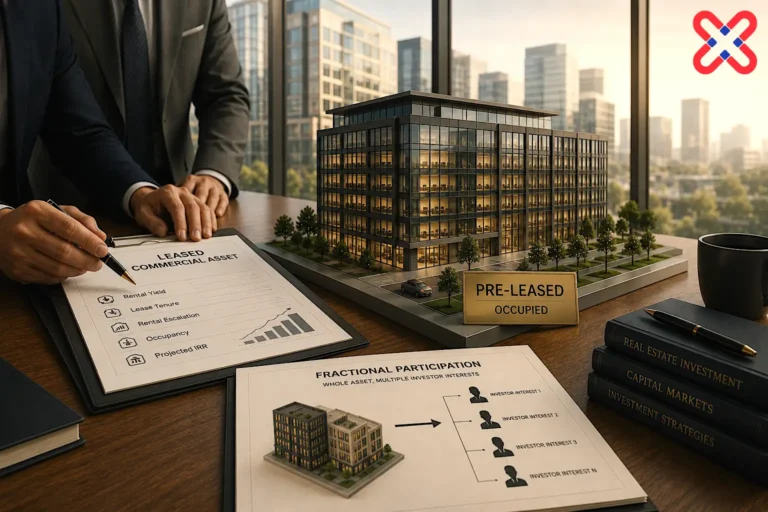

Commercial Real Estate Financing: What Matters
Commercial real estate requires substantial capital, often deployed across different stages of an asset’s lifecycle. The financing structure selected can influence project viability, execution timelines, cash flows and the financial flexibility available to developers and investors.
There is no single financing solution appropriate for every real estate project. The nature of the asset, stage of development, approvals, expected cash flows, security, leasing or sales visibility and the objectives of stakeholders can all influence how capital should be structured.
Understanding Commercial Real Estate Financing
Commercial real estate financing can support the acquisition, development, construction, stabilisation, refinancing or monetisation of income-generating properties.
Funding requirements can change considerably during the lifecycle of an asset. Capital required during construction may have different characteristics from financing required after a property becomes operational and begins generating stable rental income.
The financing structure should therefore reflect both the immediate capital requirement and the stage at which the underlying project or asset is positioned.
Understanding the Capital Requirement
Before evaluating financing alternatives, developers and investors should establish how much capital is required, when it will be required and how it is expected to be repaid.
Project costs may include land or acquisition consideration, construction expenditure, statutory charges, professional costs, financing expenses and contingencies. The timing of these requirements can be as important as the total amount.
A financing structure that does not adequately account for the timing of project expenditure can create liquidity pressure even where the underlying development remains commercially viable.
Construction Finance
Construction finance is generally structured around the development requirements of a project and the expected progression of construction.
Lenders may consider factors including promoter contribution, approvals, construction progress, project economics, sales or leasing visibility, expected cash flows and the developer’s execution track record.
Disbursements may be linked to project milestones and utilisation requirements. Developers should therefore assess whether the proposed facility provides sufficient flexibility to support the construction schedule and expected expenditure profile.
The objective should not simply be to maximise borrowing, but to ensure that available capital remains appropriately aligned with project execution.
Structured Finance
Certain real estate requirements may not fit conventional lending structures.
Structured finance can provide greater flexibility where the nature of the asset, stage of development, cash-flow profile or transaction requires a more customised approach. Depending on the circumstances, structures may incorporate senior debt, subordinated or mezzanine capital, private credit or other forms of financing.
Greater structural flexibility can also involve different pricing, security, repayment and risk considerations.
The suitability of structured finance should therefore be evaluated in relation to the underlying project economics and expected source of repayment rather than solely on the availability of capital.
Financing Stabilised Assets
Once a commercial property is operational and generates predictable rental income, financing alternatives may differ from those available during development.
Lease rental discounting and other forms of cash-flow-backed financing can potentially enable property owners to raise capital against contracted rental streams, subject to tenant quality, lease terms, occupancy, asset characteristics and lender requirements.
Such financing may be used to refinance existing obligations, release capital for other requirements or align borrowing more closely with the income profile of the asset.
The stability and durability of rental cash flows therefore become important considerations in determining financing capacity.
Refinancing Existing Debt
Real estate financing requirements do not necessarily end when the original facility has been arranged.
As a project progresses, its risk profile, cash flows and underlying asset value may change. Financing arranged during an earlier stage may no longer be appropriate once construction advances, leasing improves or the asset becomes operational.
Refinancing may therefore be considered to modify repayment schedules, align debt with revised cash flows, consolidate existing facilities or transition from development finance to a longer-term structure.
The benefits of refinancing should be assessed after considering transaction costs, security requirements, repayment obligations and the overall suitability of the proposed structure.
What Capital Providers Evaluate
Banks, non-banking financial companies, housing finance companies, alternative investment funds, private credit providers and other institutional capital sources may evaluate real estate opportunities differently.
However, several considerations commonly influence financing decisions.
These can include project viability, promoter experience, statutory approvals, location, market demand, construction progress, sales or leasing visibility, projected cash flows, security coverage, existing indebtedness and execution track record.
The relative importance of each factor can change according to the nature of the project and the type of financing being sought.
Cash-Flow Visibility and Repayment
A financing structure ultimately requires a credible source of repayment.
For a development project, repayment may depend on customer collections, asset sales or subsequent refinancing. For an income-producing asset, rental cash flows may provide the principal source of debt servicing.
Financing assumptions should therefore be tested against realistic timelines rather than only expected outcomes.
Delays in construction, sales, leasing or collections can materially affect liquidity. Appropriate contingency planning can help ensure that the financing structure remains workable if execution differs from initial projections.
Pricing Is Only One Consideration
Interest cost is naturally important, but the lowest-priced facility may not always be the most appropriate.
Tenure, repayment schedule, moratorium, security, covenants, prepayment conditions, disbursement flexibility and other commercial terms can materially influence the suitability of a financing proposal.
A facility with a lower headline cost but a repayment structure that does not correspond with expected cash generation may create greater financial pressure than a more appropriately structured alternative.
Financing proposals should therefore be compared on their overall commercial implications rather than pricing alone.
A Practical Illustration
Consider a developer planning a Grade-A commercial office project requiring approximately ₹180 crore of capital.
The land is already owned, key statutory approvals are substantially in place and discussions have commenced with prospective anchor tenants. The project nevertheless requires significant capital during construction before rental income becomes available.
Rather than assessing the requirement solely in terms of the maximum debt available, the developer should consider promoter contribution, construction milestones, expected leasing progress, timing of disbursements and the eventual transition to an income-generating asset.
Construction finance may support the development phase, while a different financing structure could become appropriate once the property achieves meaningful occupancy and rental cash-flow visibility.
The financing strategy can therefore evolve with the project rather than remain unchanged throughout its lifecycle. The original Knowledge Paper similarly emphasised aligning construction milestones and expected cash flows rather than relying entirely on one funding source.
Common Financing Mistakes
Real estate projects can encounter financing pressure even when the underlying asset has strong commercial potential.
Common issues include underestimating total project costs, relying on short-tenure funding for long-term requirements, insufficient contingency planning, delays in obtaining approvals, optimistic cash-flow assumptions and selecting financing primarily on headline pricing.
Another risk is arranging capital without adequately considering how subsequent project stages will be financed. A structure that addresses today’s requirement but creates an unsuitable repayment obligation before the project generates sufficient cash flows can constrain execution later.
Financing decisions should therefore be considered across the expected lifecycle of the project.
Structuring Capital Around the Asset
The appropriate real estate financing structure depends on the characteristics of the project rather than on a predetermined funding product.
A development-stage project, a completed but unsold asset and a stabilised income-producing property can each require different approaches to capital.
Careful assessment of project economics, capital requirements, approvals, execution progress, cash-flow visibility and repayment strategy can help determine which financing alternatives warrant consideration.
Ultimately, well-structured real estate financing should do more than provide access to capital. It should support project execution, maintain appropriate financial flexibility and remain aligned with the commercial lifecycle of the underlying asset.
Looking to Discuss an Opportunity?
Connect with Magnet Capital Partners to discuss your requirements and explore how our advisory capabilities may assist.
Disclaimer
This article forms part of Insights — The Magnet Knowledge Series and is intended solely for general informational and educational purposes. It does not constitute investment, financial, legal, tax, regulatory, real estate or other professional advice, nor does it constitute an offer, solicitation, recommendation or assurance in relation to any investment, transaction, product, service or return.
Any information, views, examples, calculations, illustrations, scenarios, projections, estimates or references to valuations, yields, returns, interest rates, financial performance, market conditions or other quantitative or qualitative measures contained in this article are general or illustrative in nature. They should not be interpreted as actual, assured, promised or indicative future outcomes. Actual circumstances and outcomes may differ materially depending upon applicable facts, assumptions, market conditions, commercial considerations, regulatory requirements and other relevant factors.
Readers should undertake their own evaluation and obtain appropriate independent professional advice before making any investment, financial, business, transaction, real estate or other decision. Information contained in this article may change over time and may not reflect subsequent developments. Magnet Capital Partners makes no representation or warranty, express or implied, regarding the accuracy, completeness or continuing relevance of the information contained herein and accepts no liability arising from reliance upon or use of this article, to the extent permitted by applicable law.
Copyright
© Magnet Capital Partners. All rights reserved.
The original editorial content, organisation, structure and presentation of Insights — The Magnet Knowledge Series are protected by applicable copyright laws. No part of this article may be reproduced, republished, distributed, transmitted, adapted or commercially used, in whole or in substantial part, without the prior written permission of Magnet Capital Partners, except as permitted by applicable law. References to third-party information, data, regulations, concepts, terminology, trademarks or other materials remain subject to the rights of their respective owners, where applicable.